



THE EDITOR'S CORNER
One disadvantage of the conventional Hawley retainer1 is that the wire traverses the occlusion between the canines and the first premolars, where it can cause interferences that may disturb the form and function achieved by orthodontic therapy.2-6 If the first premolars have been extracted, the retainer wire will act as a wedge, reopening the extraction spaces.2
Some clinicians have attempted to overcome this problem by soldering Adams clasps to the retainer.2,7 Such a modification does not completely eliminate occlusal interference, however, because the Adams clasps adapt to the interproximal surfaces of the posterior teeth. Soldering circumferential retention clasps2,4,5,7 to the retainer instead of Adams clasps places welds in locations where they are subject to intense masticatory forces.
The Ricketts retainer is designed so that the transocclusal wire passes between the canines and the lateral incisors, but this requires space in those areas.6,8 A circumferential wraparound design, from the most posterior tooth on one side to the most posterior tooth on the other,6,8 has questionable mechanical retention because of the length of wire extending across the irregular cervical surfaces of the teeth.6 In addition, the wire is easily distorted and difficult to adjust.9
Similar articles from the archive:
- TECHNIQUE CLINIC Simplified Multistranded Retainers May 2002
- New, Esthetic Organic Polymer Maxillary Retainers May 2001
- A New Thermoplastic Retainer November 1997
We have designed a circumferential wraparound retainer with a minor modification that makes it more stable.
Retainer Design
The retainer is formed on the cast from .032" wire extending from the most posterior tooth on one side to the most posterior tooth on the other. The wire should be adapted to the buccal contours of the incisors, canines, and premolars, the cervical surfaces of the molars, and, at the distal ends, to the palatal mucosa, so it will provide adequate retention for the acrylic covering the palate. Adjustment loops are added in the canine regions (Fig. 1).
Our modification is the addition of a small amount of acrylic in the premolar areas (Fig. 2). This material is secured to the buccal retainer wire by welding short segments of .019" X.025" wire to the retainer at the center of each premolar crown. Unlike a retainer with full occlusal coverage, ours allows the teeth to respond individually to the forces of mastication.
After the palatal acrylic has been added (Fig. 3), the retainer is finished and polished (Fig. 4).
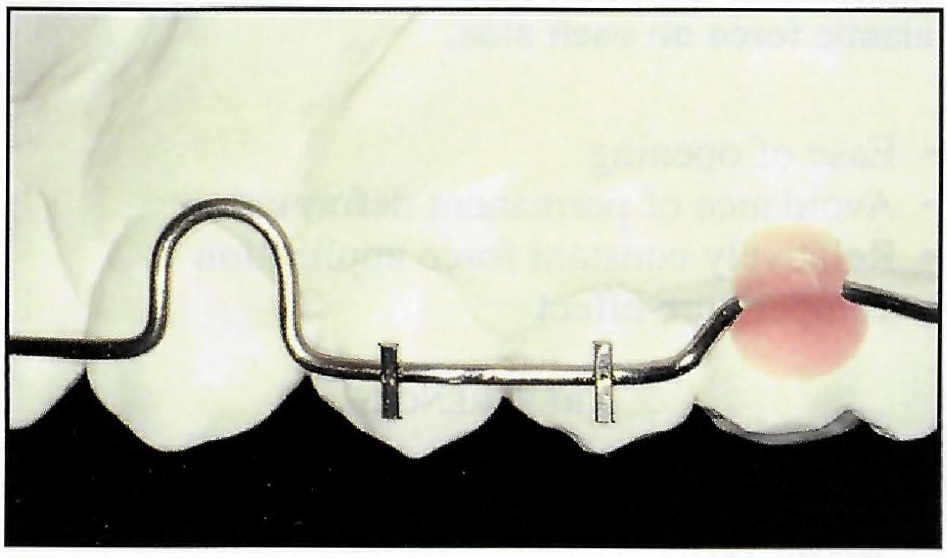
Fig. 1 Retainer secured to cast with small piece of wax; adjustment loops placed in canine region.
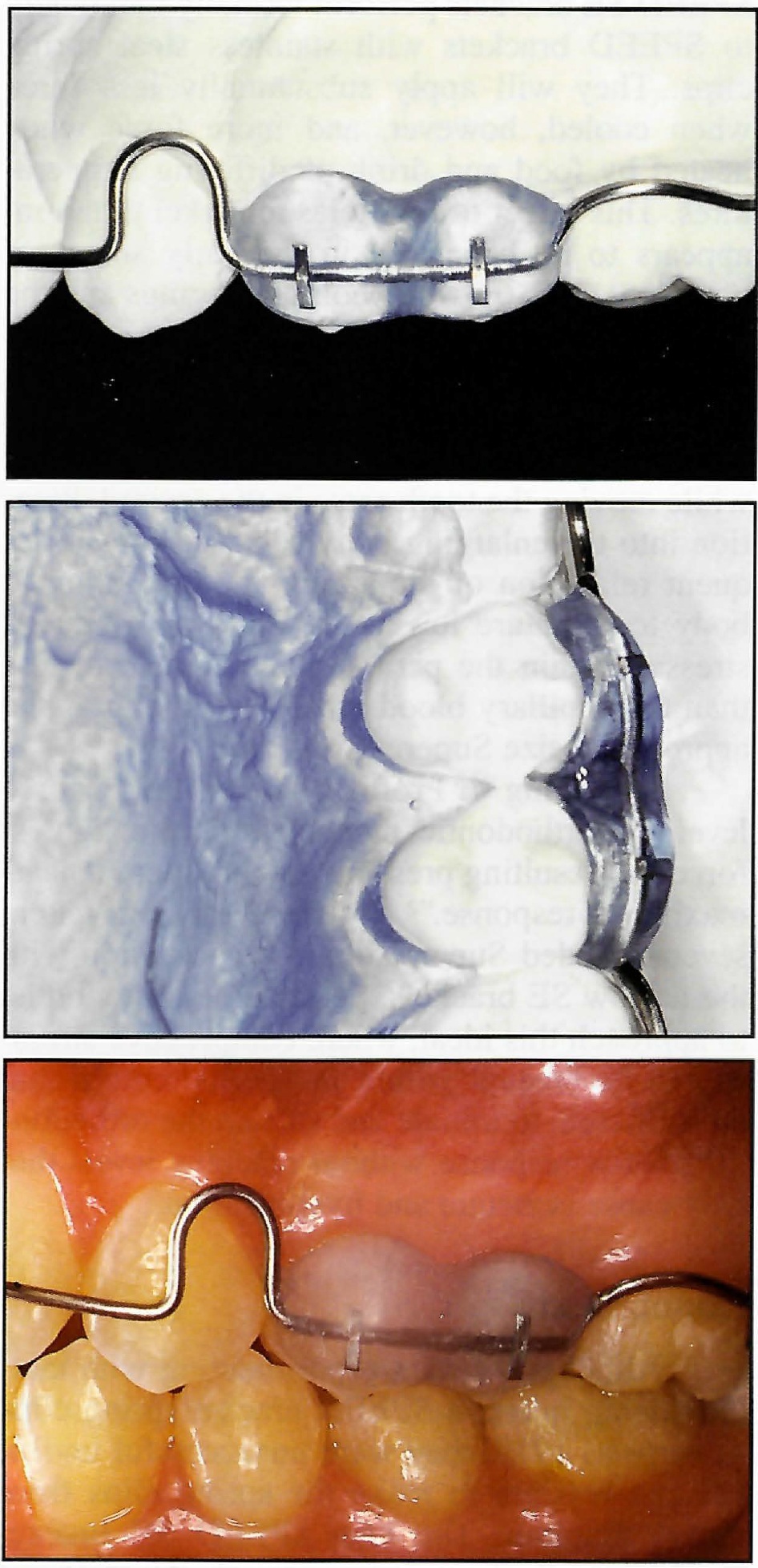
Fig. 2 Added acrylic secured to retainer wire with short segments of .019" × .025" wire welded at center of each premolar crown.
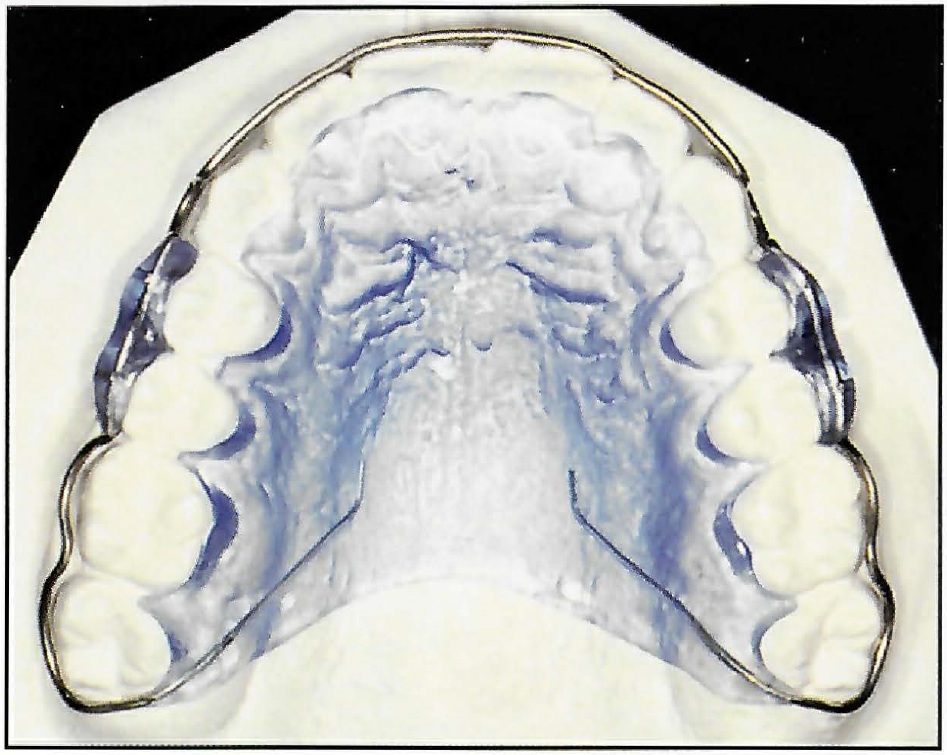
Fig. 3 Palatal acrylic coverage.
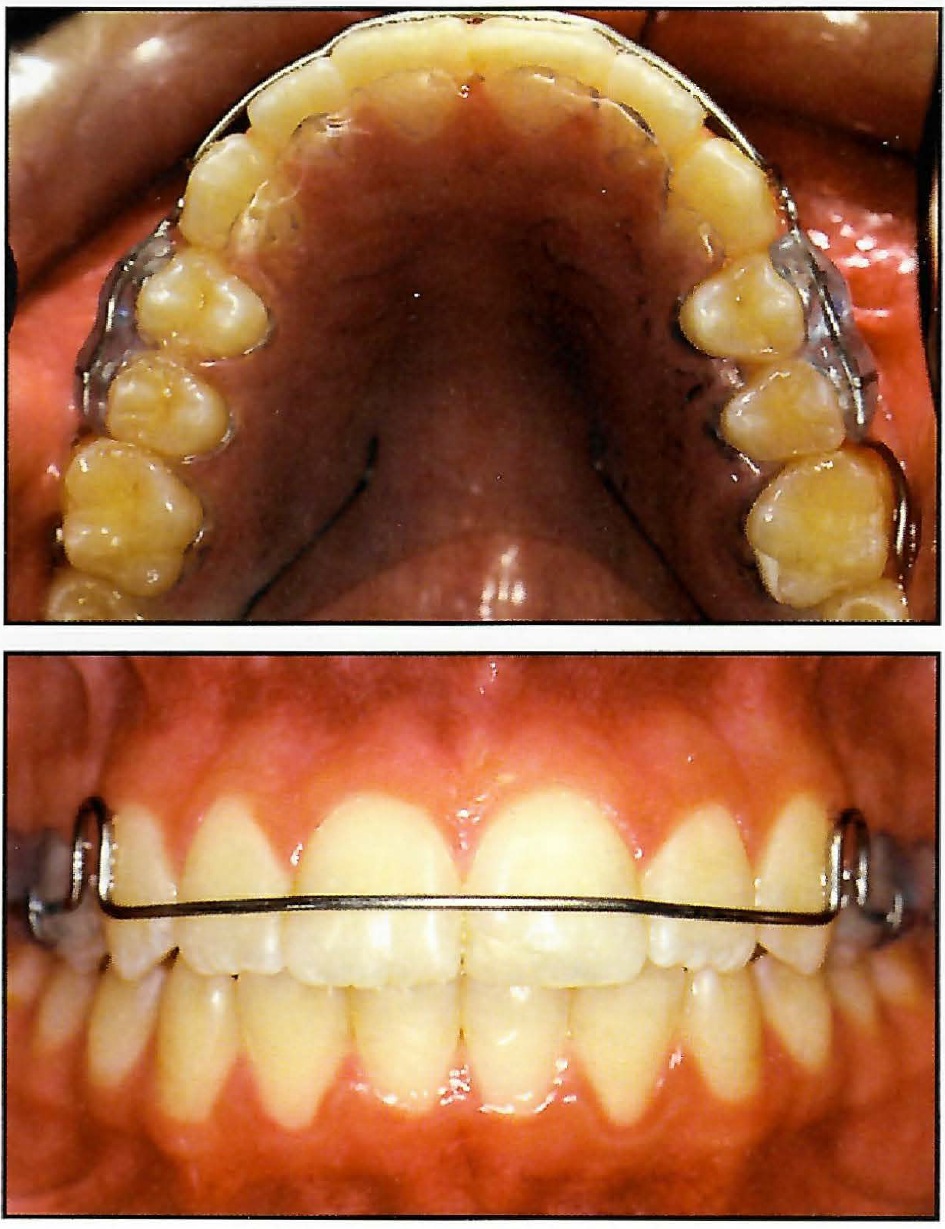
Fig. 4 Finished retainer.
Conclusion
The wraparound retainer presented here has the following advantages:
- Avoidance of occlusal interference.
- Anterior stability in the incisogingival direction.
- Rigidity of the buccal retainer wire.
- No need for soldering.
- Ease of fabrication in the laboratory.
- Acceptable esthetics.
- Ability to accommodate quick adjustments.
REFERENCES
- 1. Hawley, C.A.: A removable retainer, Int. J. Orthod. 5:291-305, 1919.
- 2. Proffit, W.R. and Fields, H.W.: Contenção, in Ortodontia Contemporânea, 2nd ed., Guanabara Koogan, Rio de Janeiro, 1995, p. 488.
- 3. Bengtson, A.L. and Bengtson, N.G.: Sugestão de um alpaca retentora para contenção ortodôntica, Rev. APCD 50:333-336, 1996.
- 4. Cabrera, C.A. and Cabrera, M.C.: Capítulo in Ortodontia Clínica, 1st ed., Produções Interativas, Curitiba, 1997, pp. 417-422.
- 5. Moyers, R.E.: Sistemas de forças e respostas dos tecidos às forças em ortodontia, in Ortodontia, 2nd ed., Guanabara Koogan, Rio de Janeiro, 1991, p. 258.
- 6. Mucha, J.N.: Técnica de confecção de grampos, in Grampos e Placas Ortodônticas Introdução á Técnica Básica de Laboratório, Guanabara Koogan, Rio de Janeiro, 1997, p. 7.
- 7. Almeida, R.R.; Bagdasaryan, K.; and Ribas, J.A.: A placa de Hawley e sua utilização clínica, Rev. Faculd. Odontol. Lins. 2:6-10, 1989.
- 8. Petrelli, E.: Capítulo in Ortodontia Contemporânea, 2nd ed., Sarvier, São Paulo, 1993, pp. 133-135.
- 9. Postlethw aite, K.: Orthodontic retention: How and why, Dent. Update 21:22-26, 1994.
-
 DR. LOCKS
 -
 DR. WESTPHALEN
 -
DR. RITTER
-
DR. RIBEIRO
-
DR. MENEZES
-
DR. ROCHA
-
DR. DERECH
-
DR. DA ROSA
From the Department of Orthodontics and Facial Orthopedics, Federal University of Santa Catarina, Florianópolis, SC, Brazil. E-mail: arnolocks@hotmail.com.br.